
Trace the fascinating and complex history of Aviva over three centuries.
Our ancestors include the oldest mutual life insurer, the first company to issue a burglary policy, and the first and only insurance company to hold a royal warrant. Uncover a wealth of history with our Timeline.
1900s
More
1900s
1901
First motor fire engine
The Norwich Union fire brigade at Worcester took delivery of a new appliance in 1901. At the time it was said to be the only motor fire engine in service in England. It had been converted from a horse-drawn vehicle into a self-propelled steamer by Charles T Crowden of Leamington. Early trials were somewhat disastrous, however, as sparks from the motor caused a series of incidents, including setting fire to the blouse of a lady cyclist and a passing waggon load of straw.
1904
Toronto fire
A spectacular blaze in Toronto, Canada, started in a necktie factory and raged through the night of 19-20 April. With no water for the fire engines, the city was engulfed, and a small arms factory caught fire and blew up. Fortunately, there was no loss of life. The blaze destroyed three-and-a-half blocks and 120 buildings, causing damage estimated at $10 million. Commercial Union paid out $40,000 as a result.
1905
Skipper’s masterpiece
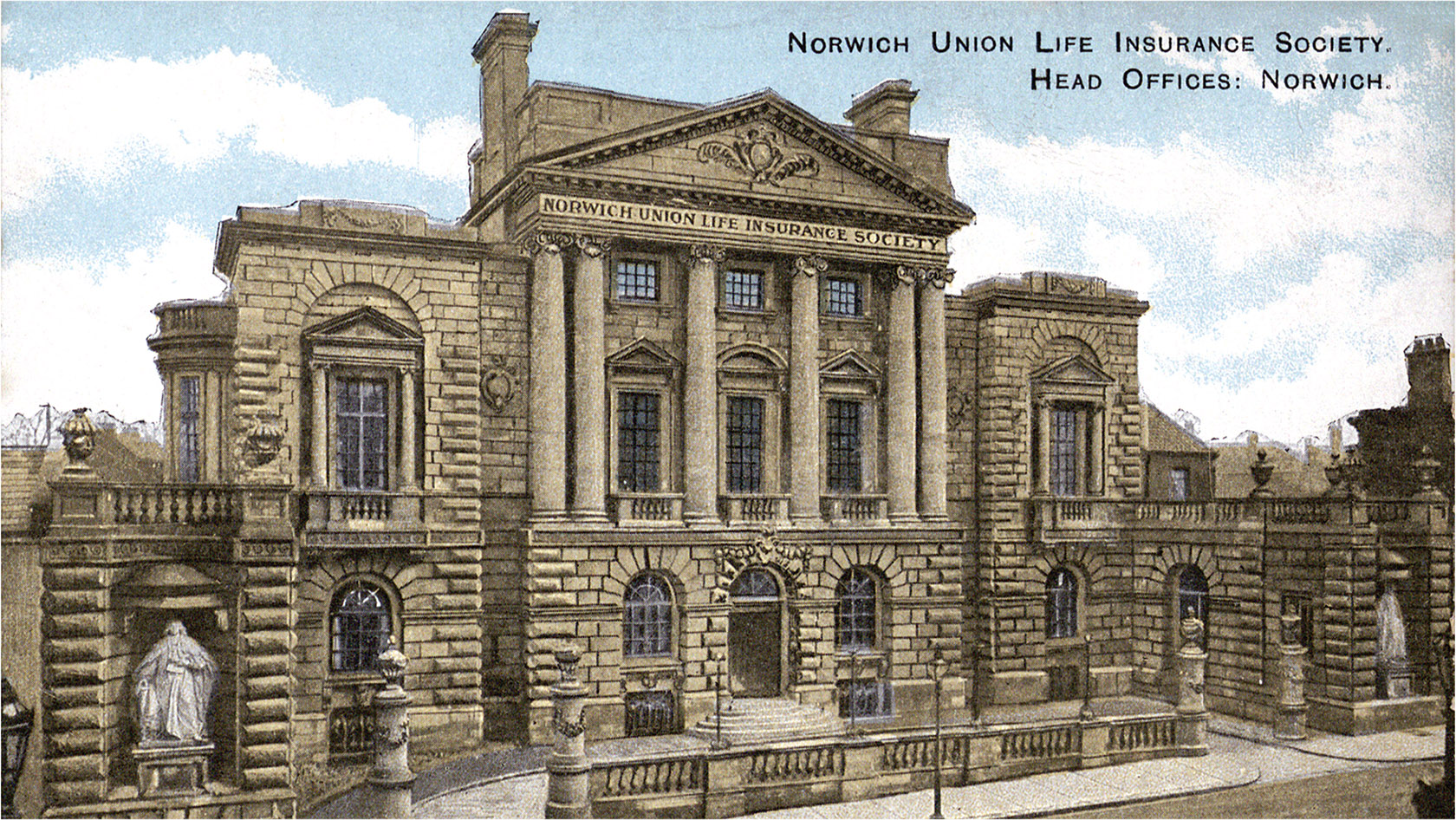
The Norwich Union Life Society’s purpose-built head office, Surrey House, first opened to the public on 1 January 1905. The architect was George Skipper. The interior is richly decorated in marble, some of which was originally intended for Westminster Cathedral. Today, the building houses the Aviva Group Archive and forms an impressive main entrance for visitors. Surrey House received Grade I listed status in 1972.
1905
Hand in Hand acquired
Commercial Union acquired the Hand in Hand Fire and Life Insurance Society in 1905. At the time, the Hand in Hand, which was established in 1696, was the oldest existing insurance company in the UK.
1906
San Francisco disaster
San Francisco was woken by a powerful earthquake on the morning of 18 April 1906. A ruptured gas mains and sparks from newly installed electrical equipment led to fires that ravaged the city for three days. Many insurers paid claims in full. This included our legacy companies, Scottish Union & National, and North British & Mercantile. The latter paid out £666,000 and was included on a "roll of honor" listing companies that had met their obligations at once and honourably.
1907
Matchstick artist
British painter L S Lowry joined General Accident in 1907. He worked as a clerk in the Manchester claims office until 1910. Lowry was to become one of the most popular British artists of the twentieth century, best known for his atmospheric paintings of bleak industrial towns populated by matchstick figures.
1908
Hibernian established
The Hibernian Fire & General Insurance Company was established in Dublin on 28 May 1908. The company mainly provided fire insurance, concentrating on public authority business from the Dublin Corporation. In 1964, Commercial Union acquired a controlling stake in the company. Its remaining shares were acquired by CGU plc in January 2000. Hibernian remained the Group’s brand name in Ireland until 2010.
1908
No claims bonus
General Accident was the first UK insurer to introduce a no-claims bonus for homeowners. The company granted a free policy renewal every sixth year for its customers.
1910s
1911
By appointment to royalty
General Accident insured so many members of the British royal family, as well as their cars, that it was granted a Royal Warrant in 1911. To the best of our knowledge, General Accident was the first and only insurance company to have held this honour. It was subsequently decided to limit royal warrants to tradesmen.
1912
Sinking of the Titanic
The Titanic sank on 15 April 1912 after striking an iceberg. More than 1,500 lives were lost. Commercial Union was just one of the companies that insured the White Star Line vessel. The owners had so much confidence in her design that they had not insured the ship for its full value. This was estimated at £1,750,000. The incident was the “heaviest individual loss that has ever befallen underwriters”, as reported by The Times newspaper in 1912. Commercial Union's share of the claim came to £145,723, of which £60,723 was for losses to registered mail from London, Hamburg, and Paris.
1914
First World War
Less than a month after the outbreak of the First World War, Joseph Marius Chazalette was killed in action. Chazalette had previously worked for L'Abeille Compagnie d'Assurances, an Aviva constituent company. His death was the first of many former employees who lost their lives in the conflict.
1920s
1924
Motor manufacturer insurance
An innovative agreement between General Accident and Morris Motors meant that every car that came off their production line was sold with a free General Accident comprehensive car insurance policy. The reduced premium of about £7 was paid by the manufacturer. The scheme lasted for two years, during which about 90,000 vehicles were covered. Although expensive in the short term, it was invaluable publicity for General Accident. It gave the company access to a nationwide network of agents in garages and reinforced its status as the UK’s leading motor insurer.
1927
Chinese parasol
Among the items in our Group Archive is a stunning Chinese ceremonial parasol. It was presented to the managing director of General Accident in 1927 by employees of the Shanghai branch. This was to honour his 40th anniversary with the corporation. An inscription on the parasol reads: “The Shanghai Far Eastern Branch Manager Brian Mitchell and all his staff, respectful congratulations. He who is imbued with sweet harmony, venerable first-born, Chief Executive of the Guarantee All Danger Company forty years of splendid and honourable Chieftainship”. It is considered by experts to be the oldest example of its type anywhere in the world.
1940s
1945
Second World War
By the end of the Second World War over 7,800 members of staff had served in the armed forces. Of this number 698 are known to have died. On the home front, those who remained took on the work of their absent colleagues, along with additional civil duties, while living under the threat of air raids and coping with wartime shortages.
1950s
1956
First computer
General Accident’s Philadelphia office installed the company’s first computer in 1956. This was an IBM 650, used for payroll and auto rating. In 1961, the company ordered its first computer for the UK business, an IBM 1401. The basis of this system was the punched card. Information was fed into the machine and stored on magnetic tape.
1959
Merger with North British and Mercantile
The North British & Mercantile Insurance Company was established in 1809. It had been applauded for paying up promptly following the San Francisco disaster of 1906. The company became a subsidiary of Commercial Union in 1959.
1959
Norwich Union acquires Scottish Union
The Scottish Union & National Insurance Company was established in 1824. Norwich Union acquired the company in 1959. This included the marine insurer, the Maritime Insurance Company, which was later sold to CNA Financial Corporation, in 1998.
1960s
1960
Don Thompson – the “Mighty Mouse”
Don Thompson, who worked for Commercial Union and was described as a "frail, bespectacled insurance clerk", won gold in the 50km walk at the 1960 Rome Olympics. He prepared for the exploit, held in the heat of the Italian summer, by walking up and down in his steam-filled bathroom. He was nicknamed "Il Topolino" or "Mighty Mouse" by the Italian spectators.
1962
Commercial Union CUTIE
Commercial Union’s first computer centre, located in Exeter, was opened in 1962. It housed a KDP 10 computer nicknamed CUTIE. This was an abbreviation of “Commercial Union Totally Integrated Electronics”. It was built by the English Electric Company at a cost of over £250,000.
1963
Presidential choice
US President John F Kennedy took out motor insurance with General Accident in 1963. The company continued to insure members of the Kennedy family until 1972. Kennedy's predecessor, President Dwight D Eisenhower, was also insured by General Accident.
1963
Great Train Robbery
The Glasgow-London Royal Mail train was hijacked on 8 August 1963 and £2.6 million stolen. Commercial Union paid out over £1 million following the incident, which came to be known as the Great Train Robbery. Rewards totalling a record £260,000 were offered by insurers, banks, and the Post Office for information leading to the arrest and conviction of the thieves. Ultimately, 12 of a gang of 15 were sentenced to jail terms totalling 307 years.
1964
The Norwich Orion
Norwich Union's first computer, a Ferranti Orion, was installed in 1964. Its successor, the Orion II, arrived in 1966. It was five times faster than the original. Personal computers were first installed in Norwich Union offices in 1980. This prompted the creation of a computer advice centre to help train and support staff.
1965
John Lennon
Sun Life’s Trafalgar Square branch in London accepted a proposal for insurance on the life of John Lennon, of Beatles fame, in 1965.
1967
Yorkshire connection
General Accident entered a takeover battle with the Phoenix that led to the acquisition of the Yorkshire Insurance Company in 1967. The deal provided the group with its links to York. The city became home to Aviva's life insurance business in the UK.
1968
Northern Assurance acquired
Commercial Union acquired Northern Assurance in 1968. Aviva's first connections with many countries around the world came through the agents of Northern Assurance. The company itself was established in 1836.
1969
New London headquarters
Commercial Union's new headquarters opened at St Helen's in the City of London in 1969. It included an automatic telephone system that, for the first time, allowed staff to dial internally or externally without the assistance of a switchboard operator. Today, the building serves as Aviva’s group head office.
1970s
1972
Flexible first
London and Manchester introduced flexible working hours for its staff in 1972. In doing so, it claimed to be a pioneer of flexible working patterns in the City of London.
1973
Commercial success
Norwich Union launched its first television advertising campaign in 1973. Its first commercial featured “Big Geordie”, a gigantic excavator believed to be Europe’s biggest at that time. The company laid claim to being the first insurer to advertise on UK television.
1980s
1986
Friendly merger
Friends’ Provident merged with the United Kingdom Provident Institution (UKP) in 1986 to become one of the UK’s top ten mutual life offices. UKP was established in 1840 as the United Kingdom Temperance and General Provident Institution.
1989
NZI acquired
NZI was acquired by the General Accident Fire and Life Assurance Corporation in 1989. NZI was established in 1859 as the New Zealand Insurance Company. It was sold in 2002.
1990s
1992
Bomb damages St Helen’s
Commercial Union's head office in London, St Helen's, was extensively damaged when an IRA car bomb exploded outside the Baltic Exchange on 10 April 1992. The blast killed three people and injured many others.
1994
Major acquisition in France
Commercial Union acquired the general insurance operations of Groupe Victoire in 1994, including its subsidiaries. These were L’Abeille Assurances, L’Abeille Vie, L’Abeille Réassurances, ACEP, AMIS, Assurop, and La Paix. The acquisition was regarded as the most important investment concluded in France by a British group to date. The French business had its origins in the 1957 merger of L’Abeille and La Paix to create La Compagnie d’Assurance Abeille et Paix (CAAP). In 1972, CAAP changed its name to Assurances-Abeille-Paix (AAP), better known as Groupe Victoire.
1994
Bupa Health Assurance established
Bupa Health Assurance Ltd was set up to offer individual and group protection to complement Bupa’s core private medical insurance offering in the UK. Bupa Health's business later merged with Friends Provident and AXA's UK Life business to form Friends Life in 2011.
1996
Provident acquisition
Provident Mutual was established in 1840. The company was acquired by General Accident in 1996. This represented a significant milestone in the development of GA’s life and pensions business.
1997
Norwich Union flotation
In the year of its bicentenary, Norwich Union demutualised and floated as a public limited company. The move, which took place on 16 June, transformed Norwich Union into a FTSE 100 company quoted on the London Stock Exchange. The £2.4 billion raised in the share offer was the largest sum ever raised in a British private sector flotation.
1998
Merger creates CGU
CGU plc was created on 2 June 1998 by the merger of Commercial Union and General Accident. The merger had been announced in February of that year. In total, CGU had operations in more than 60 countries. It employed about 20,000 people in the UK and a further 32,000 overseas.
1998
Purchase of London & Edinburgh
Norwich Union acquired London & Edinburgh from the Hartford International Financial Services Group in November 1998. The combined business became the UK's third-largest general insurer (based on premium income).
More from the Archive...

Flickr
Visual treats from our 325+ years of history.

Historypin
Hidden gems from our photograph collection on the map.

Medium
Unearth some fascinating stories from our past.
The National Archives
Explore our catalogue.
Our heritage
Our business began in an age of highwaymen but is as relevant to customers today as it was then.
About the Archive
We represent a unique and irreplaceable heritage. Find out more about the Archive and how to contact us.
Legacy companies
Our oldest constituent was established in 1696. Learn more about the companies that have come together to create Aviva.
Remembrance
In memory of our 1,623 colleagues who were killed in the two world wars.